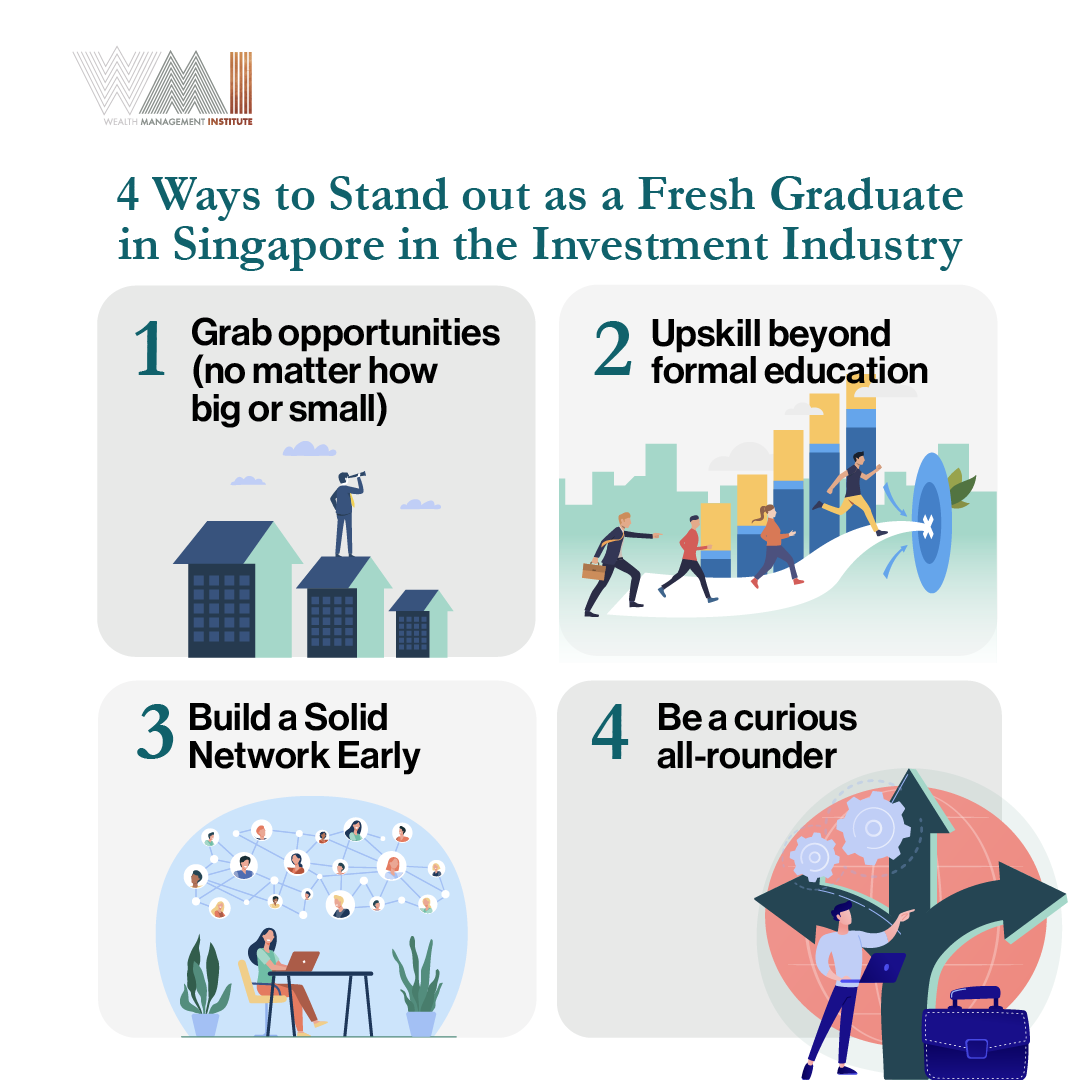
4 Ways to Stand out as a Fresh Graduate in Singapore in the Investment Industry

Share

In recent years, Singapore has emerged as a key financial center, overtaking Hong Kong to be Asia’s top financial center and third in the world. According to the Monetary Authority of Singapore (MAS), the total assets under management in Singapore increased by 16% in 2021 to S$5.4 trillion. This is more than the global increase of 12% to $112 trillion last year. This development has brought about a demand for asset managers in the country, making it the ideal time for job seekers to capitalise on the industry growth.


Take it from Kelvin Tay, the Regional Chief Investment Officer at UBS Global Wealth Management and WMI’s faculty member. “Singapore is one of the key Financial Centers globally,” says Kelvin.


With an exceptionally strong regulatory environment and solid foundations, we have been able to stand out from the other financial centers. On top of that, we have political stability and a bilingual, highly skilled workforce, which continues to attract a lot of assets from other jurisdictions. As Singapore continues to attract global public investors and asset owners, job opportunities in asset management are set to continue growing.”

As a fresh graduate in Singapore, entering the investment industry for the first time could be intimidating, especially if you lack working experience. However, with the right exposure and mindset, standing out among your peers to secure a job and a successful career is an attainable goal.


Here are four tips to help you stand out as an asset management fresh grad in Singapore.


1. Grab Opportunities – No matter how big or small

As you take your first step into the working world, it’s normal to want to aim high and go straight for the corporate giants. While the brand name of these organisations may be compelling, Kelvin advises that the smaller firms offer the breadth and depth of experience which their larger counterparts may not be able to.


The key to getting a head start in the industry, especially during your university years, is to expose yourself by doing internships at various places. There are many opportunities out there, and you don’t have to do it at very big firms… Getting the practical experience is actually very important,” says Kelvin.


Starting out in a large corporation may limit the exposure which interns get because of the way they are structured. By contrast, those who have the practical experience in a smaller firm tend to get more experience under their belt, putting them in good stead when applying for a full-time job and going for interviews with potential employers.


According to the industry veteran, in the coming year, most of the opportunities will result from the rise of family offices setting up shop in Singapore. “While the capital markets did not perform as well last year, a lot of the growth came from family offices, which is a very good area to carve out a career in. Then once you have built your capabilities, opportunities will naturally come knocking on your doors,” he adds.


2. Upskill beyond formal education

Other than internships, enrolling in adult learning or post-graduate programmes is one way to develop skills beyond those that you have acquired during formal education. The rate at which the asset management realm evolves may outpace the theoretical knowledge from college. Practical competencies and hands-on experience will be key enablers to thrive in an asset management career.


I think that’s where WMI comes in, to try to train our potential talent pool with as much practical knowledge as possible. It’s complementary to what the universities are doing, which covers foundational theory. In WMI, we focus on the practical aspects of asset management,” says the investment head and WMI faculty member. 

3. Build a Solid Network Early

As with most industry an extensive professional network in the world of asset management is an important driver of success. Building connections with experienced industry leaders and fellow peers will provide you with the work and learning opportunities that can help you to propel in your career. From new job opportunities to insightful advice, there are a myriad of benefits you can reap from established professional relationships.


Attend industry seminars and conferences, join groups of interest, or simply utilise online networking sites such as LinkedIn. Starting early in establishing rapport with likeminded peers and seasoned industry professionals goes a long way.


4. Be a Curious All-rounder

Change is a constant in the asset management field. While your technical skills will get your foot in the door, your inquisitiveness will be what gives you an edge in the industry.


To stand out from other candidates, you must demonstrate that you are truly keen on investments. Other than hard skills, other telling factors include what you do during your spare time. Do you know or read about the markets? Did you participate in any investment-related clubs or activities during your University days? When I hire, I look out not only for the aptitude but also the right attitude,” says Kelvin.

As a fresh graduate in such a rapidly evolving market environment, consistency is important. Hence, committing some time each day to learn the latest news and expand your knowledge in the sector will be instrumental to demonstrating your earnestness and commitment to your career and development.


All in all, “Never stop learning. Reading can really help you a lot. Many of us are guilty of not reading, but being disciplined is imperative in this industry. Work never ends, especially in the investment world,” adds Kelvin.


He caveats, “But it doesn’t mean you only have to read about the markets. You can read just about anything and everything. Let’s say for example, you are interested in cars. You can read about cars and electric vehicles, and all that and it might come in useful because you know the automobile industry is a big part of the investment. You’ll never know how something that you’re reading which may be seemingly frivolous and irrelevant can be very important when it comes to investments.”


This cohort-based, blended learning programme will equip you with knowledge about the asset management landscape, the impact of global macrocycles on investment performance, financial statements through the eyes of an investor, and how to build a long-term investment portfolio. By the end of the program, you will have gained practical knowledge to jumpstart your asset management career.


Gain deep insights into the investment industry directly from Kelvin at WMI’s Investment Accelerator Programme

Related Article

CEO Roundup

Alignment Under Pressure: The Real Test of Wealth Stewardship – CEO Quarterly Letter: Q2 2026 Highlights

Programme Overview

Upcoming Dates

Modules

Download programme brochure

Who Should Attend

Useful Links

Certification

Participants who successfully complete the programme will be awarded: 

Note:

Schedule

Modules

Testimonials

Enquire Now

Compliance, Risk & Governance

3 Reasons Why Private Bankers Should Learn About ESG

Programme Overview

3 Reasons Why Private Bankers Should Learn About ESG


The financial sector is experiencing significant shifts in a critical area—sustainability—alongside ongoing technological transformations. Traditionally, financial strategies have focused predominantly on maximising returns; however, a growing awareness of their environmental impact is giving rise to a new paradigm—one that today’s professionals may find challenging to navigate.


As more investors and institutions prioritise sustainability in their financial decision-making, recognising the long-term benefits it offers, the trend driven by the Environmental, Social, and Governance (ESG) framework is fundamentally reshaping our approach to wealth creation and responsible stewardship.

Mervyn Tang, who is Schroders’ Head of Sustainability, APAC, highlights three compelling reasons why private bankers should enhance their understanding of ESG to better serve their clients and future-proof their careers.


ESG: A Global Imperative Reshaping Investments


What was once a secondary consideration has now become a global imperative. The response to ESG issues, particularly climate change, is transforming how economies operate. “Governments around the world are putting policies to battle issues like climate change,” Mervyn says. “It’s changing the business models (and) the way our economy operates.”


As organisations navigate new regulations and seek incentives, such as those for electric vehicles, they must strike a balance between upfront costs and long-term objectives—ensuring their capital investments deliver sustainable returns over time.


Already, economies covering 90% of global GDP have set net zero targets, and over half of the world’s largest companies are aligning themselves with this vision. The results so far have been encouraging, with market research platform Gitnux reporting in 2024 that companies with strong ESG credentials have seen a 3-5% increase in annual revenue growth. Those with high ESG ratings also consistently outperform competitors who neglect them.


This shift creates a new role for private bankers. They’ll need to understand how these policies affect different industries, determine which are the reliable markers to prove sustainability, and how to position client portfolios for a sustainable future.


“Private bankers would be expected to talk about changes in sustainability and ESG policy in the same way as they are meant to talk about energy price inflation or Fed interest rates,” he surmises. “You’ll be expected to know more about ESG in the future.”


The senior professional explains how these fundamental concepts are discussed in WMI’s Certificate in Introduction to Climate Change and Decarbonisation Strategies programme. Besides gaining a broad perspective on topics such as climate science and international agreements in order to understand the global push for sustainability, the curriculum also includes training in core skills to assess and advise on green products and initiatives.


With outlets like Bloomberg indicating that the world’s ESG assets are projected to hit $40 trillion by 2030, informed finance professionals will stand out with their enriched knowledge and become invaluable assets to their clients’ evolving investment journey.


A Growing Emphasis Across Generations


The rise of ESG investing is not just shaped by policies. It is being fuelled by increasing demand from individuals, particularly younger generations.


“The general public is caring more about ESG,” Mervyn reveals. “You see this in search trends for things like sustainable investing and climate change.”


Figures from PricewaterhouseCoopers substantiate this observation, with a report citing that a whopping 83% of consumers expect companies to actively shape their ESG best practices, and that 76% would discontinue relations with companies which mistreat employees, communities and the environment.


“This is particularly apparent for younger generations like Gen Z or the millennials,” Mervyn notes.


A Stanford University study supports this, revealing that while only 30% of boomers were invested in ESG issues when it comes to their investments, this grew to 60% with Gen X, and became a pronounced 80% with Gen Zs and millennials.


“If these generations are more interested in sustainable investing, as we see the intergenerational transfer of wealth, more and more of your clients may want to talk about ESG in the future,” he predicts.


As ESG considerations grow increasingly complex, effective ESG investing requires integrating all three pillars—environmental, social, and governance—into the decision-making process. Beyond environmental factors, social considerations evaluate a company’s labour practices, diversity and inclusion policies, and its impact on the communities in which it operates. Governance focuses on leadership quality, transparency, and risk management practices.


WMI’s programme provides advanced modules that delve into these areas, equipping professionals with the skills to assess the right metrics and deliver comprehensive reports that support informed discussions on sustainability. By considering all three pillars of ESG alongside traditional financial analysis, private bankers can help investors capture an organisation’s long-term potential.


A Sustainable Future Unlocks New Investment Opportunities


In response to this accelerating trend, the financial sector is embracing the increasing demand for sustainable investment options.


“Sustainable investing options are increasing,” notes Mervyn, referencing both market trends and insights from his work at Schroders. “We’re talking about equities, fixed income, private assets. There’s a lot of things that your end retail investor can invest in to achieve their sustainability objectives and their financial objectives.”


The same report by Github reflects this sentiment in Asia, where 60% of retail investors have shown particular interest in ESF-focused funds, and that with the exception of Japan, allocation to ESG investing is expected to surge over 20% in Asia over the next five years.


Furthermore, the rise of digitalisation is democratising access to sustainable investments. Platforms such as crowdfunding now enable individuals to invest directly in emerging opportunities like green bonds and carbon offset initiatives—areas once limited to large institutional investors.


Rather than viewing this as competition, Mervyn emphasises that these developments highlight the need for complementary expertise. Informed private bankers can leverage their knowledge and these new tools to enhance their client offerings.


“More products means more options for your end clients to deliver what they need,” he says. “This is partly one of the reasons why asset managers are building up their sustainable investment product ranges. We see funds evolving from just your general sustainable funds to lots of different themes, to even direct private assets investing in things like renewable infrastructure.”


There’s more and more investment options for you to help cater to your clients’ financial objectives as well as sustainability objectives,” he adds.


Conclusion


The integration of ESG considerations into financial strategies is no longer a niche movement but a crucial complement to traditional finance. As private bankers navigate an evolving landscape, a solid understanding of ESG frameworks, reporting, and products becomes a vital tool for building resilient portfolios, managing risks, and fostering a more sustainable future.


WMI’s ESG programmes embrace this shift, offering a practical and industry-relevant syllabus designed by leading experts. Through engagements with senior professionals like Mervyn, participants gain real-world insights and case studies, equipping them to apply their knowledge effectively post-graduation—for the benefit of their organisation, clients, and the planet.

Upcoming Dates

Modules

Download programme brochure

Who Should Attend

Useful Links

Certification

Participants who successfully complete the programme will be awarded: 

Note:

Schedule

Modules

Testimonials

Enquire Now

Investing and Asset Management

Expert Advice on Building an Effective Multi-Asset Portfolio

Programme Overview

Upcoming Dates

Modules

Download programme brochure

Who Should Attend

Useful Links

Certification

Participants who successfully complete the programme will be awarded: 

Note:

Schedule

Modules

Testimonials

Enquire Now

Other Suggested Articles

Previous
Next