
A Beginner’s Guide to ESG Investing

Share

Environmental, Social and Governance (ESG) investing in Singapore has been gaining significant traction in recent years, spurred by the government’s ambition to position itself as Southeast Asia’s green finance hub through various strategies and schemes.


Correspondingly, there is also growing uptake for sustainable investments, as revealed in the IMAS 2023 Investment Managers’ Outlook Survey, with ESG named as a top driver of investment growth.


To uncover the importance of ESG investing and prospects for this burgeoning sector, the Wealth Management Institute (WMI) sat down with Professor Satyajit Bose, the Lead Faculty for ESG and Sustainable Investing at WMI, and Professor of Practice at Columbia University, Earth Institute.


“ESG performance refers to a company’s effort to incorporate environmental, social, and governance risks & opportunities into their business strategy and operations,” says Professor Bose. “It is critical to ensure that the pursuit of profit is not detrimental to either long-term shareholder value or societal interest.”


For asset managers, this calls for a need to integrate ESG factors into screening, due diligence, portfolio construction and risk management processes to compete in the new ESG normal and win the trust of long-term investors.


Understanding ESG Performance

ESG factors refer to the non-financial criteria and key performance indicators (KPIs) that investors use to evaluate a company’s impact on the sustainability of the social and environmental systems upon which the economy depends.


Environmental criteria assess a company’s interactions with the environment, including energy and water consumption and waste disposal. Social criteria evaluate a company’s relationships with its stakeholders in the community, including diversity, inclusion, and adherence to labour standards.


Governance criteria examine a company’s internal policies and practices, such as executive compensation and whistle-blower protection, to ensure that they are designed to safeguard the long-term interests of all shareholders and affected stakeholders. “The specific ESG factors that are most important to a business will vary depending on industry, business model, and stakeholders,” adds Professor Bose.


Presently, there is no universal ESG standard to evaluate ESG performance. Many investors rely on company-reported data and third-party assessments from ESG raters such as Sustainalytics, MSCI, Wind ESG or SynTao Green Finance . Raters construct ESG scores based on proprietary methodologies whose criteria and focus vary considerably.  While such ratings are somewhat useful for an initial assessment of ESG performance, it is essential for investors to do their own groundwork and form their own interpretation of ESG data to add value to their capital allocation process.


The Power of Sustainable Investments

Fundamentally, ESG investing creates a positive impact on the earth and society. Investors have the power to influence companies’ decisions and promote accountability through sustainable investments.


With more investors demanding accountability and responsibility over ESG matters, we are more likely to see companies taking action to enhance their sustainable and ethical practices. From increased efforts to reduce carbon emissions to significant improvements in labour protection, ESG investing is driving change towards sustainability and social responsibility in companies.


In terms of benefits for asset managers, ESG investing is a vital tool for managing risk and enhancing resilience. According to a report by MSCI, ESG-focused companies may be more resilient to external shocks and less susceptible to systematic risks. ESG investing plays a crucial role in identifying and addressing potential risks that may not be captured by classic financial analysis.


There are many ESG factors, such as social inequality and climate change, that significantly impact a company’s long-term financial performance but are often ignored through traditional assessments. Ignoring these risks can result in adverse consequences including reduced labour productivity, input inefficiency, legal liabilities, and reputational damage. By incorporating ESG considerations into investment decisions, investors are better equipped to manage these risks and achieve long-term shareholder value.


This enhanced risk management and resilience leads to lower costs and better operational efficiency, eventually boosting financial performance and investment returns. In addition to uncovering ESG growth opportunities with higher returns, a strong ESG proposition enhances investment returns by allocating capital to more sustainable opportunities and avoiding investments fraught with environmental risk.


In fact, research by sustainability data firm ESG Book showed that a model portfolio of ESG-driven companies in Asia-Pacific reaped an annual average outperformance of 1.02% over the past five years. This demonstrates that ESG considerations can boost financial performance and returns even in volatile and unfavourable market conditions across extended periods.


Emerging Trends in ESG Investing


The field of ESG investing in Singapore is set on the path to continued and exponential growth, with new trends and developments emerging regularly.


One area is an increasing recognition of how ESG factors may provide a more holistic view of investment opportunities and risks. ESG integration enables investors to factor in a broader view and may lead to better investment decision-making.


Among different investing approaches, impact investing has seen emerging interest in Singapore. “​​Impact investing provides capital to companies and funds that have a measurable positive impact on society and the environment,” explains Professor Bose. The COVID-19 pandemic also heightened interest in this area, as it showed the interconnectedness of social and environmental challenges and the need for impact considerations.


Another emerging trend in this sector surrounds fixed income investing. Equity has been the dominant asset class when it comes to ESG mandates, but the illiquid and long-term nature of bonds makes ESG analysis more vital for fixed income than equities.


With almost 20% of gross issuance in green, social, and sustainability, the growth of sustainable fixed income in Asia is set to accelerate in the coming years. Incorporating ESG investing in fixed income will attract investors who not only seek to reap high returns, but also to fulfil objectives that benefit the environment and society.


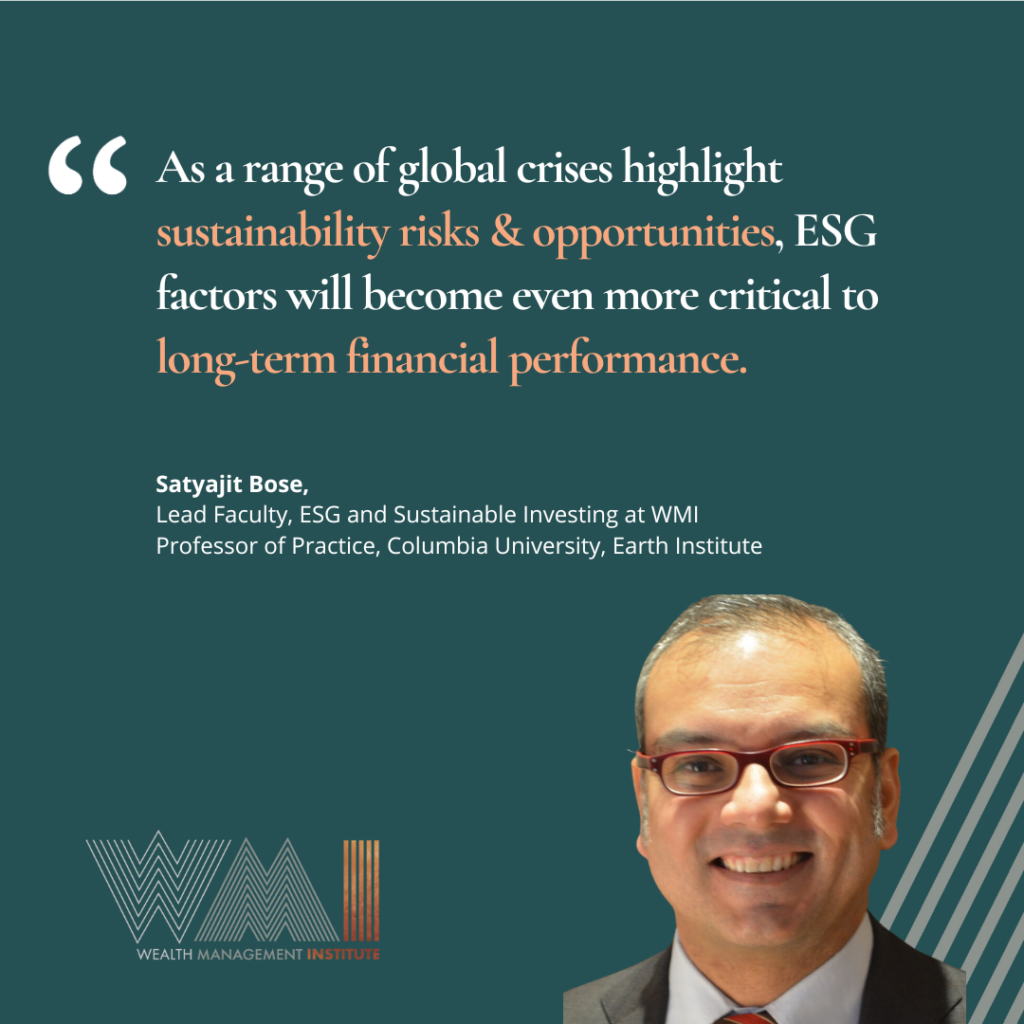
“I believe that a focus on sustainable investing, in its various forms, will continue to grow in importance in the coming years, driven both by increasing investor demand for responsible investments and widespread pressure on companies for broad societal legitimacy. As a range of global crises highlight sustainability risks & opportunities, ESG factors will become even more critical to long-term financial performance,” Professor Bose emphasises.


As clients – from retail investors to family offices and institutional investors – become increasingly concerned about environmental and social issues, ESG investing is likely to become even more mainstream in the coming years. This growing demand means that wealth and asset management professionals will need to build the right ESG skillsets to stay ahead of the curve.


Diving into ESG Investing

Success in this sector requires developing specialised skills and knowledge in key ESG aspects to effectively build and manage portfolios and meet clients’ needs. This includes training on sustainable investment techniques and ESG investment evaluation methodologies.


On top of continuous professional development and training, be sure to define your clients’ ESG values and priorities, and set clear investment objectives to build a successful ESG portfolio. It is crucial to conduct thorough analysis on potential investments and finding the right ESG investment strategy for you, be it screening strategies, ESG integration or others.


As you build and manage successful ESG portfolios, a strategy to communicate your ESG performance to stakeholders is essential. With greenwashing being an issue of great concern across industries, maintaining end-to-end transparency is key in ESG reporting.


“Companies that are transparent about their ESG performance and have strong governance practices may be seen as more trustworthy and reliable by investors, customers, employees and communities,” says Professor Bose.


Adopting an always-on approach is also an important aspect of ESG reporting. By facilitating ongoing monitoring, reporting and improvement of ESG performance, your credibility is enhanced as stakeholders are kept well-informed of your ESG efforts throughout the year.


Getting Started on Your ESG Investing Journey


As sustainability increasingly takes centre-stage in the country, asset managers must now develop a robust ESG framework to overcome ESG risks and meet the growing demands for sustainable investments.


On top of staying updated with ESG trends and developments, deepening your expertise in ESG is key to advancing in the industry.


WMI provides ESG programmes conducted by leading sustainability and ESG experts which equip you with the knowledge and skills you need to compete in the new ESG-dominated investment world.

Put your skills into practice through the upcoming Certificate in Applied ESG Investment and Advisory programme

Related Article

CEO Roundup

Alignment Under Pressure: The Real Test of Wealth Stewardship – CEO Quarterly Letter: Q2 2026 Highlights

Programme Overview

Upcoming Dates

Modules

Download programme brochure

Who Should Attend

Useful Links

Certification

Participants who successfully complete the programme will be awarded: 

Note:

Schedule

Modules

Testimonials

Enquire Now

Compliance, Risk & Governance

3 Reasons Why Private Bankers Should Learn About ESG

Programme Overview

3 Reasons Why Private Bankers Should Learn About ESG


The financial sector is experiencing significant shifts in a critical area—sustainability—alongside ongoing technological transformations. Traditionally, financial strategies have focused predominantly on maximising returns; however, a growing awareness of their environmental impact is giving rise to a new paradigm—one that today’s professionals may find challenging to navigate.


As more investors and institutions prioritise sustainability in their financial decision-making, recognising the long-term benefits it offers, the trend driven by the Environmental, Social, and Governance (ESG) framework is fundamentally reshaping our approach to wealth creation and responsible stewardship.

Mervyn Tang, who is Schroders’ Head of Sustainability, APAC, highlights three compelling reasons why private bankers should enhance their understanding of ESG to better serve their clients and future-proof their careers.


ESG: A Global Imperative Reshaping Investments


What was once a secondary consideration has now become a global imperative. The response to ESG issues, particularly climate change, is transforming how economies operate. “Governments around the world are putting policies to battle issues like climate change,” Mervyn says. “It’s changing the business models (and) the way our economy operates.”


As organisations navigate new regulations and seek incentives, such as those for electric vehicles, they must strike a balance between upfront costs and long-term objectives—ensuring their capital investments deliver sustainable returns over time.


Already, economies covering 90% of global GDP have set net zero targets, and over half of the world’s largest companies are aligning themselves with this vision. The results so far have been encouraging, with market research platform Gitnux reporting in 2024 that companies with strong ESG credentials have seen a 3-5% increase in annual revenue growth. Those with high ESG ratings also consistently outperform competitors who neglect them.


This shift creates a new role for private bankers. They’ll need to understand how these policies affect different industries, determine which are the reliable markers to prove sustainability, and how to position client portfolios for a sustainable future.


“Private bankers would be expected to talk about changes in sustainability and ESG policy in the same way as they are meant to talk about energy price inflation or Fed interest rates,” he surmises. “You’ll be expected to know more about ESG in the future.”


The senior professional explains how these fundamental concepts are discussed in WMI’s Certificate in Introduction to Climate Change and Decarbonisation Strategies programme. Besides gaining a broad perspective on topics such as climate science and international agreements in order to understand the global push for sustainability, the curriculum also includes training in core skills to assess and advise on green products and initiatives.


With outlets like Bloomberg indicating that the world’s ESG assets are projected to hit $40 trillion by 2030, informed finance professionals will stand out with their enriched knowledge and become invaluable assets to their clients’ evolving investment journey.


A Growing Emphasis Across Generations


The rise of ESG investing is not just shaped by policies. It is being fuelled by increasing demand from individuals, particularly younger generations.


“The general public is caring more about ESG,” Mervyn reveals. “You see this in search trends for things like sustainable investing and climate change.”


Figures from PricewaterhouseCoopers substantiate this observation, with a report citing that a whopping 83% of consumers expect companies to actively shape their ESG best practices, and that 76% would discontinue relations with companies which mistreat employees, communities and the environment.


“This is particularly apparent for younger generations like Gen Z or the millennials,” Mervyn notes.


A Stanford University study supports this, revealing that while only 30% of boomers were invested in ESG issues when it comes to their investments, this grew to 60% with Gen X, and became a pronounced 80% with Gen Zs and millennials.


“If these generations are more interested in sustainable investing, as we see the intergenerational transfer of wealth, more and more of your clients may want to talk about ESG in the future,” he predicts.


As ESG considerations grow increasingly complex, effective ESG investing requires integrating all three pillars—environmental, social, and governance—into the decision-making process. Beyond environmental factors, social considerations evaluate a company’s labour practices, diversity and inclusion policies, and its impact on the communities in which it operates. Governance focuses on leadership quality, transparency, and risk management practices.


WMI’s programme provides advanced modules that delve into these areas, equipping professionals with the skills to assess the right metrics and deliver comprehensive reports that support informed discussions on sustainability. By considering all three pillars of ESG alongside traditional financial analysis, private bankers can help investors capture an organisation’s long-term potential.


A Sustainable Future Unlocks New Investment Opportunities


In response to this accelerating trend, the financial sector is embracing the increasing demand for sustainable investment options.


“Sustainable investing options are increasing,” notes Mervyn, referencing both market trends and insights from his work at Schroders. “We’re talking about equities, fixed income, private assets. There’s a lot of things that your end retail investor can invest in to achieve their sustainability objectives and their financial objectives.”


The same report by Github reflects this sentiment in Asia, where 60% of retail investors have shown particular interest in ESF-focused funds, and that with the exception of Japan, allocation to ESG investing is expected to surge over 20% in Asia over the next five years.


Furthermore, the rise of digitalisation is democratising access to sustainable investments. Platforms such as crowdfunding now enable individuals to invest directly in emerging opportunities like green bonds and carbon offset initiatives—areas once limited to large institutional investors.


Rather than viewing this as competition, Mervyn emphasises that these developments highlight the need for complementary expertise. Informed private bankers can leverage their knowledge and these new tools to enhance their client offerings.


“More products means more options for your end clients to deliver what they need,” he says. “This is partly one of the reasons why asset managers are building up their sustainable investment product ranges. We see funds evolving from just your general sustainable funds to lots of different themes, to even direct private assets investing in things like renewable infrastructure.”


There’s more and more investment options for you to help cater to your clients’ financial objectives as well as sustainability objectives,” he adds.


Conclusion


The integration of ESG considerations into financial strategies is no longer a niche movement but a crucial complement to traditional finance. As private bankers navigate an evolving landscape, a solid understanding of ESG frameworks, reporting, and products becomes a vital tool for building resilient portfolios, managing risks, and fostering a more sustainable future.


WMI’s ESG programmes embrace this shift, offering a practical and industry-relevant syllabus designed by leading experts. Through engagements with senior professionals like Mervyn, participants gain real-world insights and case studies, equipping them to apply their knowledge effectively post-graduation—for the benefit of their organisation, clients, and the planet.

Upcoming Dates

Modules

Download programme brochure

Who Should Attend

Useful Links

Certification

Participants who successfully complete the programme will be awarded: 

Note:

Schedule

Modules

Testimonials

Enquire Now

Investing and Asset Management

Expert Advice on Building an Effective Multi-Asset Portfolio

Programme Overview

Upcoming Dates

Modules

Download programme brochure

Who Should Attend

Useful Links

Certification

Participants who successfully complete the programme will be awarded: 

Note:

Schedule

Modules

Testimonials

Enquire Now

Other Suggested Articles

Previous
Next