How a Compliance Specialist Transitioned from Learning to Taking on High-Stakes Projects

Share

Compliance professionals in Singapore’s financial services industry are faced with opportunities and challenges alike in an ever-evolving regulatory landscape. In an era of rapid technological advancements in the financial services industry and the promulgation of new regulations, proficient compliance professionals are essential to navigating a complex environment, and in striking a balance between growth, innovation, regulatory compliance, and robust risk management.

Laws against anti-money laundering and other financial crimes, and the penalties for non-compliance, have resulted in the immense importance placed on compliance professionals to upskill themselves so as to grasp the ins and outs of latest compliance practices.

Such is the motivation of a recent graduand of WMI’s Graduate Diploma in Compliance in Financial Services, James Wu. James is a Management Consultant – Risk, Regulation & Compliance (SEA) at Accenture Singapore. As James and his cohort of graduands would discover, the rigour of a post-graduate diploma curriculum is no mean feat for a working adult but reaps abundant rewards.

We speak with James to uncover his learning journey and how he went from learner to trailblazer at work.

Lessons straight from industry head honchos

“Hence, it was really enriching to learn from senior compliance leaders such as Loretta Yuen, who imparted valuable lessons about retail banking and fintech regulation. She went the extra mile by sharing her years of experience and the accompanying war stories as the Head of Group Legal and Compliance at OCBC bank, and I was thrilled to be able to interact and discourse with such seasoned and highly respected professionals in the industry.”

WMI’s faculty includes a range of experienced compliance industry specialists and leaders who boast expertise in the area. Participants can learn from senior leaders who can impart deep domain knowledge to provide a structured educational progression.

Gaining an invaluable network

James notes that his cohort included learners from a diverse range of financial services professional backgrounds, including legal, compliance, risk, digital strategy, and audit functions, where he has benefited from peer-to-peer learning, networks and friendships fostered across institutions.


“We have a wide spectrum of professionals in the industry. I recall having peers from the brick-and-mortar banks, fintech companies, exchanges, wealth and asset management houses. Collectively, there were a lot of interesting conversations, including the unique challenges faced in their respective organisational environment.”


The diversity in perspectives and insights help participants expand beyond their own experience and adopt a top-level, multi-disciplinary approach to topics. At work, such a range of viewpoints is appreciated, yet often overlooked, when engaging multiple departments and teams.


At WMI’s Advanced Programmes, participants further apply their interdisciplinary interactions to solve real-world case studies and problems. As James notes, “Within the classroom setting, having participants coming from such diversified backgrounds, it naturally forms a microcosm of the compliance ecosystem; you get to understand how the different pieces of [compliance] work carried out by various functions add up together. This, in turn, allows you to get a nice, holistic view of how compliance is done at the macro-level within the financial services sector”.
 

Learn and network with professionals from a diverse range of financial backgrounds through WMI’s Advanced Compliance Programmes

Empowered for Success

For James, completing the Graduate Diploma programme from WMI has brought about efficiencies and tangible improvements in his compliance work by transferring what was taught onto his projects and his presentation delivery.

“In my actual project at work, I was able to apply the course learnings directly to a substantial level, and from time to time I would even check back to the course materials to reinforce my understanding of the compliance frameworks and terminologies,” says James.

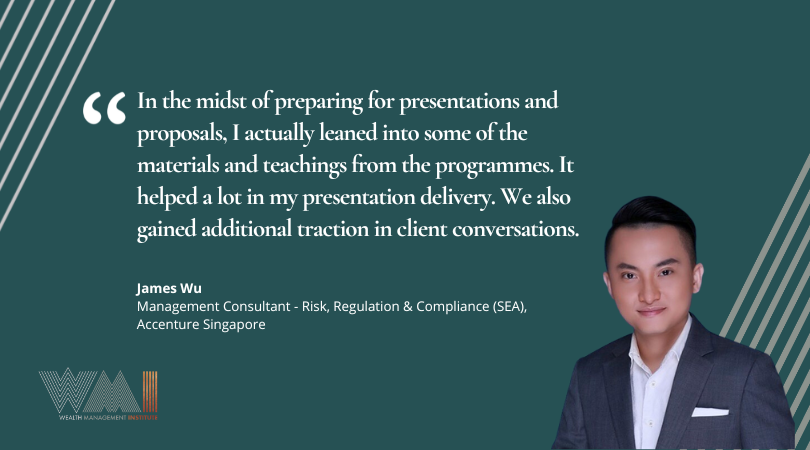
“In the midst of preparing for presentations and proposals, I was also able to lean into some of the materials and teachings from the programmes. It helped a lot in my presentation delivery. As a result of this, we also gained additional traction in client conversations.”

James has since taken on more impactful ventures and higher-stake projects at work, and he attributes his growth to his learning journey.

The sweet spot between work and upskilling

Staying committed to lifelong learning while dedicating oneself to work requires immense dedication and many of WMI’s participants do so to stay at the forefront of what they believe is essential.

In recognising the challenge of attending classes and studying whilst keeping up with the pressing demands of your full-time work, WMI’s Advanced Compliance Programmes are structured into modules of two to three days on average and spaced apart across several weeks to allow participants to upskill themselves while minimally disrupting their work commitments.

“The spaced-out format of the programme gave me the perfect balance as I was able to integrate my learning across several weeks and apply the knowledge gained,” attests James.

This programme equips students with the full range of skills and competencies across all the Compliance job families identified in the IBF National Skills Framework for Financial Services. The Graduate Diploma in Compliance empowers learners to master a comprehensive range of Compliance disciplines covering Regulatory Advisory, Financial Crimes Compliance, Compliance Analytics, Monitoring, Surveillance and Testing, and includes a Capstone project with industry mentoring to tackle real-life industry problems.
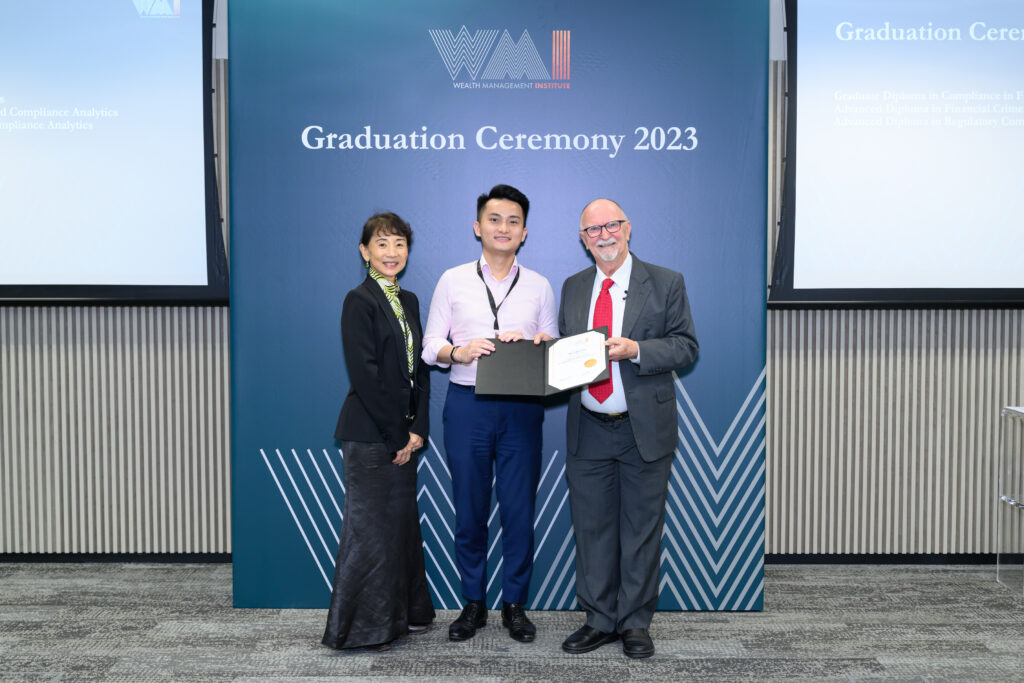
Graduates of the Graduate Diploma in Compliance in Financial Services programme will earn a WMI qualification and are eligible to apply for IBF Advanced certifications in the relevant Compliance job families.

Take your compliance career to the next level with WMI’s Advanced Compliance Programmes

Related Article

CEO Roundup

Alignment Under Pressure: The Real Test of Wealth Stewardship – CEO Quarterly Letter: Q2 2026 Highlights

Programme Overview

Upcoming Dates

Modules

Download programme brochure

Who Should Attend

Useful Links

Certification

Participants who successfully complete the programme will be awarded: 

Note:

Schedule

Modules

Testimonials

Enquire Now

Compliance, Risk & Governance

3 Reasons Why Private Bankers Should Learn About ESG

Programme Overview

3 Reasons Why Private Bankers Should Learn About ESG


The financial sector is experiencing significant shifts in a critical area—sustainability—alongside ongoing technological transformations. Traditionally, financial strategies have focused predominantly on maximising returns; however, a growing awareness of their environmental impact is giving rise to a new paradigm—one that today’s professionals may find challenging to navigate.


As more investors and institutions prioritise sustainability in their financial decision-making, recognising the long-term benefits it offers, the trend driven by the Environmental, Social, and Governance (ESG) framework is fundamentally reshaping our approach to wealth creation and responsible stewardship.

Mervyn Tang, who is Schroders’ Head of Sustainability, APAC, highlights three compelling reasons why private bankers should enhance their understanding of ESG to better serve their clients and future-proof their careers.


ESG: A Global Imperative Reshaping Investments


What was once a secondary consideration has now become a global imperative. The response to ESG issues, particularly climate change, is transforming how economies operate. “Governments around the world are putting policies to battle issues like climate change,” Mervyn says. “It’s changing the business models (and) the way our economy operates.”


As organisations navigate new regulations and seek incentives, such as those for electric vehicles, they must strike a balance between upfront costs and long-term objectives—ensuring their capital investments deliver sustainable returns over time.


Already, economies covering 90% of global GDP have set net zero targets, and over half of the world’s largest companies are aligning themselves with this vision. The results so far have been encouraging, with market research platform Gitnux reporting in 2024 that companies with strong ESG credentials have seen a 3-5% increase in annual revenue growth. Those with high ESG ratings also consistently outperform competitors who neglect them.


This shift creates a new role for private bankers. They’ll need to understand how these policies affect different industries, determine which are the reliable markers to prove sustainability, and how to position client portfolios for a sustainable future.


“Private bankers would be expected to talk about changes in sustainability and ESG policy in the same way as they are meant to talk about energy price inflation or Fed interest rates,” he surmises. “You’ll be expected to know more about ESG in the future.”


The senior professional explains how these fundamental concepts are discussed in WMI’s Certificate in Introduction to Climate Change and Decarbonisation Strategies programme. Besides gaining a broad perspective on topics such as climate science and international agreements in order to understand the global push for sustainability, the curriculum also includes training in core skills to assess and advise on green products and initiatives.


With outlets like Bloomberg indicating that the world’s ESG assets are projected to hit $40 trillion by 2030, informed finance professionals will stand out with their enriched knowledge and become invaluable assets to their clients’ evolving investment journey.


A Growing Emphasis Across Generations


The rise of ESG investing is not just shaped by policies. It is being fuelled by increasing demand from individuals, particularly younger generations.


“The general public is caring more about ESG,” Mervyn reveals. “You see this in search trends for things like sustainable investing and climate change.”


Figures from PricewaterhouseCoopers substantiate this observation, with a report citing that a whopping 83% of consumers expect companies to actively shape their ESG best practices, and that 76% would discontinue relations with companies which mistreat employees, communities and the environment.


“This is particularly apparent for younger generations like Gen Z or the millennials,” Mervyn notes.


A Stanford University study supports this, revealing that while only 30% of boomers were invested in ESG issues when it comes to their investments, this grew to 60% with Gen X, and became a pronounced 80% with Gen Zs and millennials.


“If these generations are more interested in sustainable investing, as we see the intergenerational transfer of wealth, more and more of your clients may want to talk about ESG in the future,” he predicts.


As ESG considerations grow increasingly complex, effective ESG investing requires integrating all three pillars—environmental, social, and governance—into the decision-making process. Beyond environmental factors, social considerations evaluate a company’s labour practices, diversity and inclusion policies, and its impact on the communities in which it operates. Governance focuses on leadership quality, transparency, and risk management practices.


WMI’s programme provides advanced modules that delve into these areas, equipping professionals with the skills to assess the right metrics and deliver comprehensive reports that support informed discussions on sustainability. By considering all three pillars of ESG alongside traditional financial analysis, private bankers can help investors capture an organisation’s long-term potential.


A Sustainable Future Unlocks New Investment Opportunities


In response to this accelerating trend, the financial sector is embracing the increasing demand for sustainable investment options.


“Sustainable investing options are increasing,” notes Mervyn, referencing both market trends and insights from his work at Schroders. “We’re talking about equities, fixed income, private assets. There’s a lot of things that your end retail investor can invest in to achieve their sustainability objectives and their financial objectives.”


The same report by Github reflects this sentiment in Asia, where 60% of retail investors have shown particular interest in ESF-focused funds, and that with the exception of Japan, allocation to ESG investing is expected to surge over 20% in Asia over the next five years.


Furthermore, the rise of digitalisation is democratising access to sustainable investments. Platforms such as crowdfunding now enable individuals to invest directly in emerging opportunities like green bonds and carbon offset initiatives—areas once limited to large institutional investors.


Rather than viewing this as competition, Mervyn emphasises that these developments highlight the need for complementary expertise. Informed private bankers can leverage their knowledge and these new tools to enhance their client offerings.


“More products means more options for your end clients to deliver what they need,” he says. “This is partly one of the reasons why asset managers are building up their sustainable investment product ranges. We see funds evolving from just your general sustainable funds to lots of different themes, to even direct private assets investing in things like renewable infrastructure.”


There’s more and more investment options for you to help cater to your clients’ financial objectives as well as sustainability objectives,” he adds.


Conclusion


The integration of ESG considerations into financial strategies is no longer a niche movement but a crucial complement to traditional finance. As private bankers navigate an evolving landscape, a solid understanding of ESG frameworks, reporting, and products becomes a vital tool for building resilient portfolios, managing risks, and fostering a more sustainable future.


WMI’s ESG programmes embrace this shift, offering a practical and industry-relevant syllabus designed by leading experts. Through engagements with senior professionals like Mervyn, participants gain real-world insights and case studies, equipping them to apply their knowledge effectively post-graduation—for the benefit of their organisation, clients, and the planet.

Upcoming Dates

Modules

Download programme brochure

Who Should Attend

Useful Links

Certification

Participants who successfully complete the programme will be awarded: 

Note:

Schedule

Modules

Testimonials

Enquire Now

Investing and Asset Management

Expert Advice on Building an Effective Multi-Asset Portfolio

Programme Overview

Upcoming Dates

Modules

Download programme brochure

Who Should Attend

Useful Links

Certification

Participants who successfully complete the programme will be awarded: 

Note:

Schedule

Modules

Testimonials

Enquire Now

Other Suggested Articles

Previous
Next